

Rebuilding Neural Pathways.
Restoring Human Movement.
A next-generation neural rerouting platform designed to restore
motor function after stroke and neurological injury
The brain still knows how to walk.
The wiring is what’s broken.
After stroke, motor intention often remains intact, but the signal cannot traverse damaged cortical tissue. Axon Shift is engineered to detect voluntary locomotor intent from the functional hemisphere and dynamically reroute that signal to intact subcortical gait networks below the lesion. The system activates only during intentional walking attempts and remains inactive at rest or during upper-limb tasks. Its objective is not permanent substitution, but guided circuit reactivation, adaptive plasticity, and long-term functional restoration.
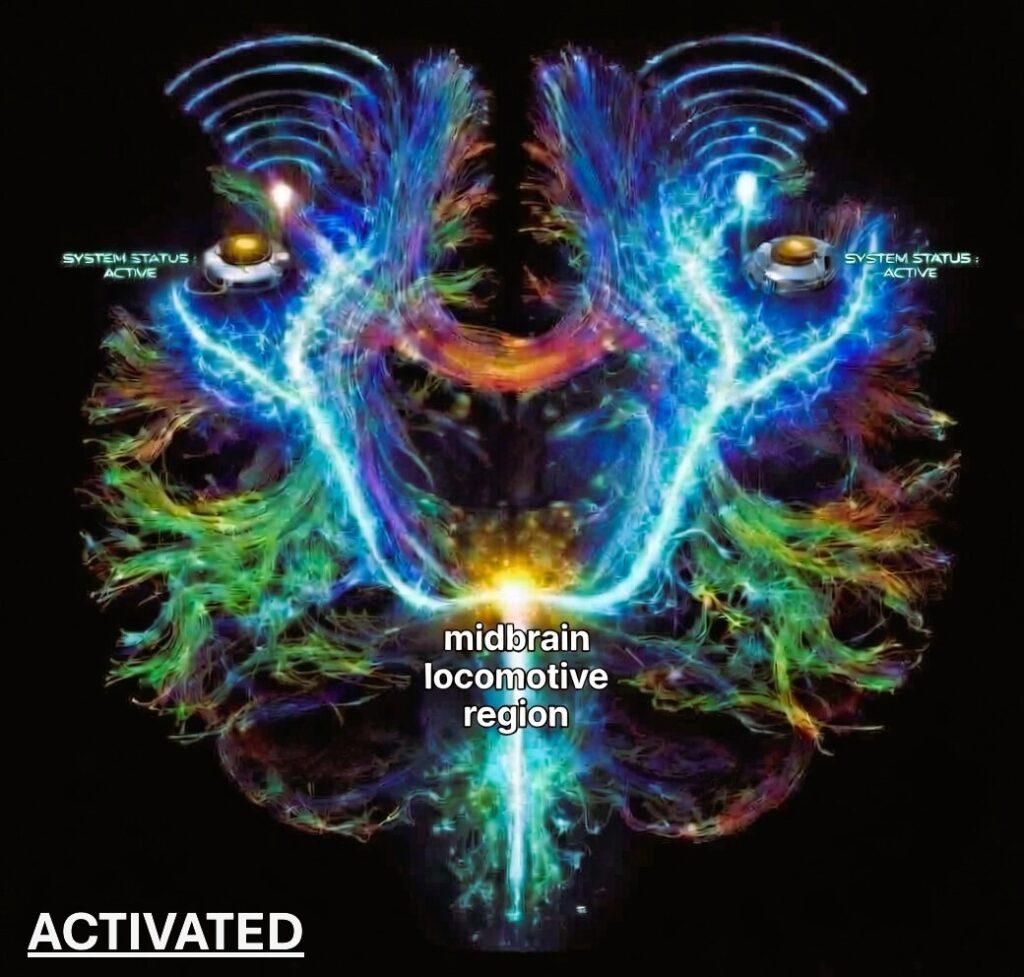
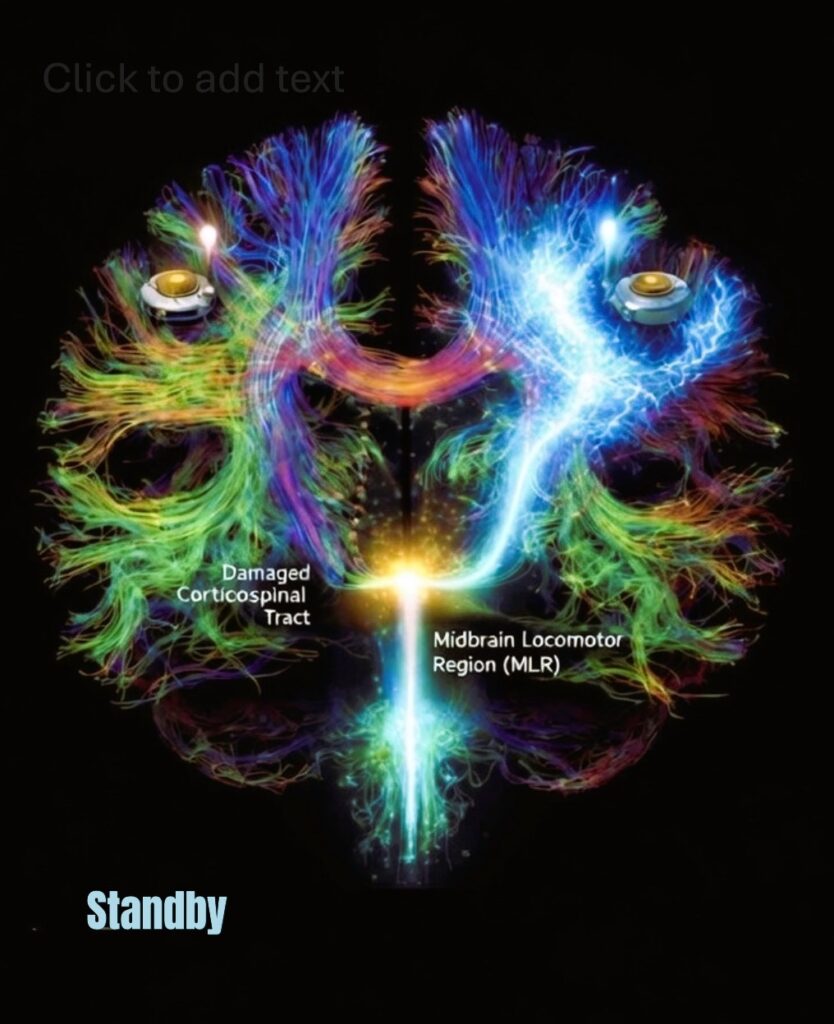
Axon Shift – Midbrain Locomotor Gearbox
Locomotor control in humans emerges from a distributed network in which cortical intention is transformed into rhythmic stepping through brainstem and spinal circuits. A key hub in this hierarchy is the mesencephalic locomotor region (MLR), encompassing structures such as the pedunculopontine nucleus (PPN) and cuneiform nucleus (CnF). Experimental and translational work shows that stimulation of these regions can bias locomotion toward different speed regimes, with evidence suggesting functional specialization along a continuum from PPN-associated slow, stable gait initiation and postural control to CnF-associated higher-speed and more vigorous locomotion, supporting the concept of a midbrain “gearbox” that regulates locomotor drive and intensity. This brainstem control interacts with spinal central pattern generator circuitry responsible for rhythm generation and muscle coordination. Importantly, supraspinal input from motor cortex remains essential for volitional initiation, adaptation, and modulation of gait, and growing human neurophysiology literature indicates that walking speed is strongly linked to cadence (step-cycle frequency) and to phase- and frequency-dependent oscillatory corticospinal activity during locomotion. Studies combining EEG, EMG, and corticospinal measures demonstrate that cortical oscillations and descending motor drive exhibit speed-dependent modulation, consistent with the interpretation that the cortex can tune locomotor output through frequency modulation of descending signals that shape stepping rhythm and muscle activation timing. Together, these findings support a hierarchical but interactive model in which cortical intention provides a frequency-modulated control signal that engages midbrain locomotor circuits—effectively selecting and tuning “gears”—while downstream brainstem–spinal networks generate the coordinated stepping pattern.
References
Ryczko & Dubuc, The mesencephalic locomotor region and locomotor control, 2017. • Caggiano et al., Midbrain circuits that set locomotor speed and gait selection, 2018. • Capelli et al., Distinct brainstem locomotor pathways and speed control, 2017. • Le Ray et al., Functional organization of locomotor brainstem networks, 2011. • Takakusaki, Functional neuroanatomy of posture and gait control, 2017. • Petersen et al., Corticospinal control and cortical oscillations during human walking, 2012. • Roeder et al., Phase-dependent corticospinal excitability during gait, 2018. • Seeber et al., Cortical oscillatory dynamics during human locomotion, 2015. • Gwin et al., Electrocortical activity during treadmill walking and speed changes, 2011. • Knaepen et al., Human cortical activity and cadence modulation during walking, 2015.
Evidence Base & Scientific Foundation
Together, these studies demonstrate that locomotor recovery emerges from distributed descending motor networks and can be strengthened through activity-dependent, task-specific, and closed-loop activation. Evidence from stroke, brain injury, and neuromodulation research supports the role of corticoreticular, brainstem, and spinal locomotor circuits in compensatory gait recovery, forming the biological foundation for task-gated approaches such as Axon Shift.
Brainstem Locomotor Networks
- The mesencephalic locomotor region contains diverse neuron populations that initiate and modulate stepping, posture, and gait transitions. Ryczko D. (2024).
- Locomotion is driven by distributed brainstem circuits integrating cortical commands and sensory input. Noga BR. (2022).
- Pedunculopontine nucleus stimulation can influence gait and posture, highlighting clinical relevance of brainstem locomotor circuits. Alam M. (2011).
Multi-Tract Walking Recovery
- Walking recovery depends on multiple descending pathways beyond the corticospinal tract. Soulard J. et al. (2020).
- Structural integrity across motor pathways improves prediction of motor outcomes after stroke. Stinear CM. (2014).
- Preservation of alternative descending tracts is associated with gait recovery and compensatory plasticity. Yeo SS et al. (2020).
Corticoreticular Pathways
- The corticoreticular pathway contributes to posture and gait recovery in chronic stroke. Jang SH. (2013).
- Alternative motor pathways support post-stroke motor control when corticospinal integrity is compromised. Qiu A. et al. (2024).
- Corticoreticular tract integrity predicts gait and balance outcomes in diffusion imaging studies. Jun HJ et al. (2021).
Traumatic Brain Injury
- Corticoreticular pathway injury can produce gait disturbance even in mild traumatic brain injury. Lee HD & Jang SH. (2015).
- Delayed gait impairment after TBI may reflect degeneration of alternative descending pathways. Kwon HG. (2014).
Closed-Loop Rehabilitation
- Closed-loop strategies enhance gait recovery by synchronizing stimulation with intention and sensory feedback. de Seta D. et al. (2025).
- EMG-triggered functional electrical stimulation reinforces activity-dependent plasticity during walking attempts. Lee JH. (2020).
- Task-specific functional electrical stimulation improves motor recovery through repetitive activation. Allen JL. (2018).
Patent Portfolio
The AxonShift platform is supported by a family of granted U.S. patents titled “Patient-initiated automatic control of neural tissues.” These patents collectively describe a framework in which motor intention signals from intact brain regions are used to activate neural tissue adjacent to or below damaged pathways, enabling restoration of voluntary movement and promoting neuroplastic recovery.
US 10,118,039 B1
Introduces the core concept of linking preserved motor intention signals from the intact hemisphere to downstream motor circuits, stimulating neural tissue below a damaged pathway to create a functional bridge for voluntary movement.
US 10,420,942 B1
Expands the architecture for patient-initiated neural control and reinforces targeted stimulation strategies supporting recovery following stroke and traumatic brain injury.
US 11,013,923 B1
Advances patient-initiated neural control mechanisms enabling voluntary intention signals to trigger therapeutic neural stimulation aligned with task-specific activation.
Contact Axon Shift
For research inquiries, collaboration, or investment discussions